Bala Kanda · Sarga 1 of 77 · 100 verses
Narada Tells the Whole Story in Brief
The poem opens with a question. Valmiki, a sage devoted to austerity and study, asks the divine traveller Narada whether there is anyone alive in the world today who has every virtue at once: strong yet truthful, learned yet gentle, fearsome in battle yet free of anger.
Narada answers that such qualities rarely meet in one person, but there is one: Rama, born in the line of Ikshvaku. He describes Rama’s body and character, and then tells the whole story in about eighty verses, from the planned coronation and Kaikeyi’s two boons, through the exile, Sita’s abduction, the alliance with Sugriva, Hanuman’s leap, the bridge, the war and Sita’s ordeal by fire, to the return to Ayodhya and a golden reign.
The sarga ends with the blessing traditionally promised to anyone who reads or hears this story. Because it summarises the entire epic, this sarga is called the Sankshepa Ramayana, “the Ramayana in brief”, and many recite it on its own.
Press › to begin with verse 1.
Valmiki asks Narada 1.1.1 तपः स्वाध्यायनिरतं तपस्वी वाग्विदां वरम् । नारदं परिपप्रच्छ वाल्मीकिर्मुनिपुङ्गवम् ॥ १ ॥
The ascetic Valmiki questioned Narada, who is ever devoted to austerity and to study of the Veda, best of those who know speech, foremost among sages:
तपस्वी वाल्मीकि ने नारद जी से पूछा, जो तप और वेद के स्वाध्याय में सदा लगे रहते हैं, वाणी के जानकारों में श्रेष्ठ हैं और मुनियों में अग्रणी हैं:
Commentary on the whole sarga
An epic that begins with a question Why the Ramayana opens with a list of virtues, not a battle. 2 min read.
Read the commentary CommentaryNot scripture The first word of the whole Ramayana is tapah , “austerity”, the inner heat a seeker builds through discipline. The poem opens not with a king or a war but with two sages and a question. Read the grammar closely: “the ascetic” is Valmiki, but the long praise (devoted to austerity and study, best of those who know speech) belongs to Narada. Valmiki honours his teacher before he asks. Narada is called vag-vid , a master of speech, and that is fitting: this is the story of how a poet finds his words.
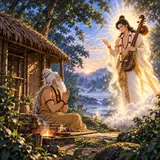
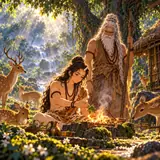
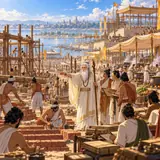
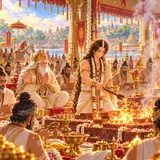
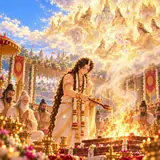
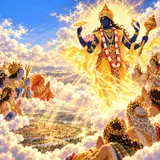
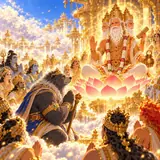
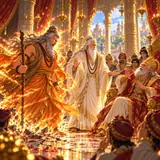
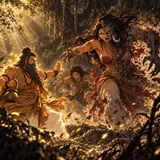
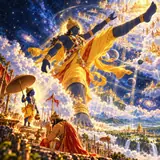
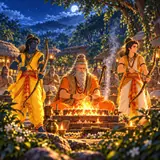
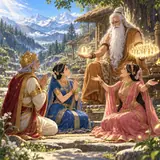
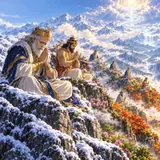
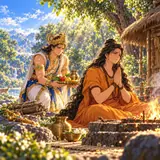
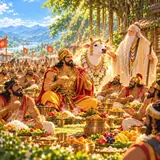
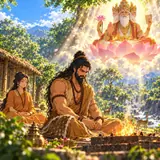
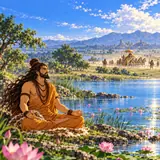
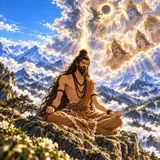
Scene 1 of 16 · At dawn in his hermitage, Valmiki asks the celestial sage Narada his question.
को न्वस्मिन्साम्प्रतं लोके गुणवान्कश्च वीर्यवान् । धर्मज्ञश्च कृतज्ञश्च सत्यवाक्यो दृढव्रतः ॥ २ ॥
“Who in this world today has every virtue, and who has valour? Who knows dharma, who is grateful, who speaks the truth, who is firm in his vows?
“इस संसार में आज ऐसा कौन है जो गुणवान भी हो और पराक्रमी भी? कौन धर्म को जानता है, कौन किए हुए उपकार को मानता है, कौन सत्य बोलता है और कौन अपने व्रत पर अटल रहता है?
CommentaryNot scripture Valmiki asks about “this world, today”: a living person, not a hero of legend. Notice how he pairs the gentle with the strong. Gunavan (good) sits beside viryavan (brave); dharmajna (knows what is right) beside dridhavrata (firm in vows). Kritajna , grateful, is the surprise. Gratitude is rarely listed among heroic virtues, yet the story will turn on it more than once. Hold this list in mind: every later crisis tests one of these qualities.
Scene 1 of 16 · At dawn in his hermitage, Valmiki asks the celestial sage Narada his question.
चारित्रेण च को युक्तः सर्वभूतेषु को हितः । विद्वान्कः कः समर्थश्च कश्चैकप्रियदर्शनः ॥ ३ ॥
“Who has good conduct, and who wishes well to every living being? Who is learned, who is capable, and who alone is a delight to behold?
“कौन सदाचार से युक्त है, और कौन सभी प्राणियों का हित चाहता है? कौन विद्वान है, कौन समर्थ है, और कौन अकेला ऐसा है जिसे देखना ही आनंद देता है?
CommentaryNot scripture Two phrases here reach far. Sarva-bhuteshu hitah : one who wishes well to every being, not only to his own people. And eka-priya-darshanah : “the one who is a delight to see”. In Indian devotion darshana , seeing the holy, is itself a blessing. Valmiki places beauty among the virtues because, in this poem, the outer form shines with the inner goodness.
Scene 1 of 16 · At dawn in his hermitage, Valmiki asks the celestial sage Narada his question.
आत्मवान्को जितक्रोधो द्युतिमान्कोऽनसूयकः । कस्य बिभ्यति देवाश्च जातरोषस्य संयुगे ॥ ४ ॥
“Who is master of himself, who has conquered anger? Who is radiant, who is free of envy? Whom do even the gods fear when his anger is roused in battle?
“किसने अपने मन को वश में किया है, किसने क्रोध को जीत लिया है? कौन तेजस्वी है, कौन किसी के गुणों में दोष नहीं ढूँढता? और युद्ध में जिसके क्रोधित होने पर देवता भी डरते हैं, वह कौन है?
CommentaryNot scripture The list ends with a paradox. In one breath Valmiki asks for a man who has conquered anger (jita-krodha ), and then for a man whose anger in battle frightens even the gods. These are not opposites. He wants anger mastered, not anger absent: a man who never rages for himself, but whose anger, when justice calls for it, is terrible. Counted together, verses 2 to 4 give sixteen qualities, and tradition likes to compare them with the sixteen digits (kala ) of the full moon.
Scene 1 of 16 · At dawn in his hermitage, Valmiki asks the celestial sage Narada his question.
एतदिच्छाम्यहं श्रोतुं परं कौतूहलं हि मे । महर्षे त्वं समर्थोऽसि ज्ञातुमेवंविधं नरम् ॥ ५ ॥
“This I wish to hear; my longing to know is very great. Great sage, you are able to know of such a man.”
“यह मैं सुनना चाहता हूँ, इसे जानने की मेरी उत्कंठा बहुत बड़ी है। हे महर्षि, आप ऐसे पुरुष को जानने में समर्थ हैं।”
CommentaryNot scripture Valmiki is not asking idly. Kautuhalam means an eager, burning wish to know. He also trusts that Narada can know such a man. From this verse on, the whole Ramayana is an answer to one question, and you, the reader, are invited to sit beside Valmiki and ask it with him.
Scene 1 of 16 · At dawn in his hermitage, Valmiki asks the celestial sage Narada his question.
श्रुत्वा चैतत्त्रिलोकज्ञो वाल्मीकेर्नारदो वचः । श्रूयतामिति चामन्त्र्य प्रहृष्टो वाक्यमब्रवीत् ॥ ६ ॥
Hearing Valmiki’s words, Narada, who knows the three worlds, said “Listen”, and gladly spoke:
वाल्मीकि के ये वचन सुनकर, तीनों लोकों को जानने वाले नारद ने उन्हें “सुनिए” कहकर संबोधित किया और प्रसन्न होकर बोले:
CommentaryNot scripture Narada is tri-loka-jna , “knower of the three worlds”: he travels heaven, earth and the worlds below, so he is the right witness for a question about “anyone in the world”. His first word is shruyatam , “listen”. It is spoken to Valmiki, and also to everyone who has ever opened this book. And he is prahrishta , delighted: the question lets him speak of Rama.
Scene 2 of 16 · Narada smiles and begins: “Listen.”
बहवो दुर्लभाश्चैव ये त्वया कीर्तिता गुणाः । मुने वक्ष्याम्यहं बुद्ध्वा तैर्युक्तः श्रूयतां नरः ॥ ७ ॥
“The many virtues you have named are rare indeed. Sage, having considered, I will tell you of the man who has them. Listen.
“हे मुनि, आपने जिन बहुत से गुणों का वर्णन किया है, वे दुर्लभ हैं। फिर भी मैं विचार करके आपको उस पुरुष के बारे में बताता हूँ जिसमें ये सब गुण हैं। सुनिए।
CommentaryNot scripture Narada agrees that such virtues rarely meet (durlabhah ). Then come two small words that matter. Buddhva , “having considered”: he does not answer on impulse, he weighs the claim before he makes it. And he does not say “there is no such man”. He says “there is one, listen”. Rare is not the same as impossible. That hope is where the Ramayana begins.
Scene 2 of 16 · Narada smiles and begins: “Listen.”
इक्ष्वाकुवंशप्रभवो रामो नाम जनैः श्रुतः । नियतात्मा महावीर्यो द्युतिमान्धृतिमान्वशी ॥ ८ ॥
“Born in the line of Ikshvaku, he is known among the people by the name Rama. He is self-controlled, of great valour, radiant, steadfast and master of his senses.
“इक्ष्वाकु वंश में जन्मे वे लोगों में राम नाम से प्रसिद्ध हैं। वे मन को साधे हुए, महापराक्रमी, तेजस्वी, धैर्यवान और इंद्रियों को वश में रखने वाले हैं।
CommentaryNot scripture The answer arrives in a name. After four verses of “who?”, Narada says ramo nama , “Rama by name”, and adds janaih shrutah , “known among the people”. He is not a hidden saint; ordinary people already know him. Look at the first qualities Narada gives: niyatatma (self-controlled) and vashi (master of the senses) frame mahavirya (great valour). Strength is held inside restraint, which answers Valmiki’s paradox about anger.
Scene 3 of 16 · Rama as Narada describes him: deep as the ocean, steady as the Himalaya, lovely as the moon.
बुद्धिमान्नीतिमान्वाग्मी श्रीमाञ्छ्त्रुनिबर्हणः । विपुलांसो महाबाहुः कम्बुग्रीवो महाहनुः ॥ ९ ॥
“He is wise, versed in right policy, eloquent, glorious, a destroyer of foes. His shoulders are broad, his arms mighty, his neck marked with lines like a conch shell, his jaw strong.
“वे बुद्धिमान, नीति के ज्ञाता, वाणी में कुशल, शोभा से युक्त और शत्रुओं का नाश करने वाले हैं। उनके कंधे चौड़े हैं, भुजाएँ विशाल हैं, गर्दन शंख जैसी रेखाओं वाली है और ठोड़ी दृढ़ है।
CommentaryNot scripture Now Narada turns from character to body, and the order matters: mind first (wise, versed in policy, eloquent), then form. The body is a warrior’s: broad shoulders, mighty arms, a strong jaw. “A neck like a conch” (kambu-griva ) means a neck with three soft lines, an old Indian mark of good fortune. These are not random compliments. Indian texts on bodily marks (samudrika ) read such features as signs of a great king.
Scene 3 of 16 · Rama as Narada describes him: deep as the ocean, steady as the Himalaya, lovely as the moon.
महोरस्को महेष्वासो गूढजत्रुररिन्दमः । आजानुबाहुः सुशिराः सुललाटः सुविक्रमः ॥ १० ॥
“His chest is deep, his bow great, his collarbones well covered with flesh; he subdues his enemies. His arms reach to his knees, his head and brow are finely shaped, his stride is noble.
“उनकी छाती चौड़ी है, धनुष महान है, हँसली की हड्डियाँ मांस से ढकी हैं, और वे शत्रुओं का दमन करते हैं। उनकी भुजाएँ घुटनों तक लंबी हैं, सिर और ललाट सुंदर हैं, और चाल श्रेष्ठ है।
CommentaryNot scripture “His arms reach to his knees” (ajanu-bahu ) is the most famous mark of all, given to great heroes and kings in Indian tradition: long arms that can protect many. Gudha-jatru , collarbones not showing, means a well-built, strong frame. Maha-ishvasa , “of the great bow”, is the first time his bow appears. It will be his signature through the whole poem.
Scene 3 of 16 · Rama as Narada describes him: deep as the ocean, steady as the Himalaya, lovely as the moon.
समः समविभक्ताङ्गः स्निग्धवर्णः प्रतापवान् । पीनवक्षा विशालाक्षो लक्ष्मीवाञ्छुभलक्षणः ॥ ११ ॥
“He is well proportioned, his limbs evenly formed, his complexion glowing; he is full of splendour. His chest is full, his eyes large; he is graced with good fortune and bears every auspicious mark.
“उनका शरीर संतुलित है, अंग सुडौल और समान हैं, रंग चिकना और चमकीला है, वे प्रतापी हैं। उनका वक्ष भरा हुआ है, आँखें बड़ी हैं, वे लक्ष्मी से युक्त हैं और उनमें सभी शुभ लक्षण हैं।
CommentaryNot scripture Snigdha-varna : a glossy, glowing complexion. Valmiki does not yet say “dark”; later the poem will call Rama shyama , dark like a rain cloud. Lakshmivan , “graced by Lakshmi”, can mean fortune and splendour, and devotees also hear in it the goddess Lakshmi, who will be born as Sita. Sama , “balanced”, sums up the whole description: nothing in him is too much or too little.
Scene 3 of 16 · Rama as Narada describes him: deep as the ocean, steady as the Himalaya, lovely as the moon.
धर्मज्ञः सत्यसन्धश्च प्रजानां च हिते रतः । यशस्वी ज्ञानसम्पन्नः शुचिर्वश्यः समाधिमान् ॥ १२ ॥
“He knows dharma and is true to his word, devoted to the good of his people. He is renowned, full of knowledge, pure, disciplined and of collected mind.
“वे धर्म को जानते हैं, अपनी प्रतिज्ञा के सच्चे हैं और प्रजा के हित में लगे रहते हैं। वे यशस्वी, ज्ञानी, पवित्र, संयमी और एकाग्र चित्त वाले हैं।
CommentaryNot scripture Back to character. Satya-sandha , “true to his vow”, is the quality the story will test most cruelly: within a few verses his father’s promise will send him to the forest, and he keeps it without complaint. Prajanam hite ratah , “devoted to his people’s good”: Rama is a ruler before he is anything else. Samadhiman means a settled, collected mind.
Scene 3 of 16 · Rama as Narada describes him: deep as the ocean, steady as the Himalaya, lovely as the moon.
प्रजापतिसमः श्रीमान् धाता रिपुनिषूदनः । रक्षिता जीवलोकस्य धर्मस्य परिरक्षिता ॥ १३ ॥
“Like Prajapati himself, he is glorious, a sustainer, a slayer of enemies. He is the protector of all living beings and the guardian of dharma.
“वे प्रजापति के समान शोभावान, सबका पालन करने वाले और शत्रुओं का संहार करने वाले हैं। वे सभी प्राणियों के रक्षक और धर्म के रखवाले हैं।
CommentaryNot scripture Prajapati is the creator who sustains all beings. Narada compares Rama to him because a true king, in Indian thought, holds the world together the way the creator does. Notice the pairs again: dhata (sustainer) and ripu-nishudana (slayer of foes). Protecting and destroying are two sides of one duty: guarding dharma.
Scene 3 of 16 · Rama as Narada describes him: deep as the ocean, steady as the Himalaya, lovely as the moon.
रक्षिता स्वस्य धर्मस्य स्वजनस्य च रक्षिता । वेदवेदाङ्गतत्त्वज्ञो धनुर्वेदे च निष्ठितः ॥ १४ ॥
“He guards his own duty and guards his own people. He knows the truth of the Vedas and their limbs, and is accomplished in the science of archery.
“वे अपने धर्म की और अपने लोगों की रक्षा करते हैं। वे वेद और वेदांगों का सार जानते हैं और धनुर्वेद में पारंगत हैं।
CommentaryNot scripture Rama guards “his own dharma” and “his own people”. Svadharma is one’s own duty, the path that fits one’s place in life. He is learned in the Vedas and also a master of dhanurveda , the science of archery. Scholar and warrior in one person is exactly what Valmiki asked for in verse 2.
Scene 3 of 16 · Rama as Narada describes him: deep as the ocean, steady as the Himalaya, lovely as the moon.
सर्वशास्त्रार्थतत्त्वज्ञो स्मृतिमान् प्रतिभानवान् । सर्वलोकप्रियः साधुरदीनात्मा विचक्षणः ॥ १५ ॥
“He knows the meaning and essence of every shastra, has a sure memory and quick insight. Loved by all the world, he is good, never mean in spirit, and discerning.
“वे सभी शास्त्रों का अर्थ और सार जानते हैं, उनकी स्मृति पक्की है और सूझ तुरंत होती है। वे सारे संसार के प्रिय, सज्जन, उदार मन वाले और विवेकी हैं।
CommentaryNot scripture Smritiman and pratibhanavan : a sure memory and quick insight, the slow and the fast kinds of intelligence. Adinatma , “never mean in spirit”, is lovely: he never shrinks, never begs, never becomes small, even in exile. Sarva-loka-priya , loved by all the world, prepares us for the grief of Ayodhya when he leaves.
Scene 3 of 16 · Rama as Narada describes him: deep as the ocean, steady as the Himalaya, lovely as the moon.
सर्वदाभिगतः सद्भिः समुद्र इव सिन्धुभिः । आर्यः सर्वसमश्चैव सदैव प्रियदर्शनः ॥ १६ ॥
“The good always come to him, as rivers come to the sea. He is noble, equal toward all, and always a joy to see.
“जैसे नदियाँ समुद्र के पास जाती हैं, वैसे ही सज्जन सदा उनके पास आते हैं। वे श्रेष्ठ हैं, सबके प्रति समान भाव रखते हैं, और उन्हें देखना सदा सुख देता है।
CommentaryNot scripture The first of the poem’s great similes: the good come to Rama “as rivers come to the sea”. Rivers do not need to be called; they flow to the ocean by nature. In the same way good people are drawn to him without any effort on his part. Sarva-sama , “equal toward all”, means he treats prince and forest-dweller alike, which the story will show with Guha, Shabari and the vanaras.
Scene 3 of 16 · Rama as Narada describes him: deep as the ocean, steady as the Himalaya, lovely as the moon.
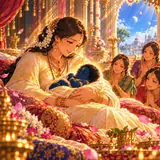
स च सर्व गुणोपेतः कौसल्यानन्दवर्धनः । समुद्र इव गाम्भीर्ये धैर्येण हिमवानिव ॥ १७ ॥
“He has every virtue and increases the joy of Kausalya. In depth he is like the ocean, in steadiness like the Himalaya.
“सभी गुणों से युक्त वे माता कौसल्या का आनंद बढ़ाने वाले हैं। गहराई में वे समुद्र के समान और धैर्य में हिमालय के समान हैं।
CommentaryNot scripture Kausalya is named here before anyone else in Rama’s family. Rama is first his mother’s joy. Then two images of greatness: deep as the ocean (gambhirya , depth of mind, never shallow or shaken) and steady as the Himalaya (dhairya , firmness that no storm moves). Ocean and mountain, the lowest and the highest things on earth, both describe one man.
Scene 3 of 16 · Rama as Narada describes him: deep as the ocean, steady as the Himalaya, lovely as the moon.
विष्णुना सदृशो वीर्ये सोमवत्प्रियदर्शनः । कालाग्निसदृशः क्रोधे क्षमया पृथिवीसमः ॥ १८ ॥
“In valour he is like Vishnu, in loveliness like the moon. In anger he is like the fire at the end of time, in patience like the earth.
“पराक्रम में वे विष्णु के समान हैं और चंद्रमा की तरह देखने में प्रिय हैं। क्रोध में वे प्रलय की अग्नि के समान और क्षमा में पृथ्वी के समान हैं।
CommentaryNot scripture Four comparisons in two pairs, each pair holding opposites. In valour like Vishnu, in loveliness like the moon: power and gentleness. In anger like the fire at the end of time (kalagni , the fire that ends the universe), in patience like the earth, which bears everything. This is Valmiki’s answer to his own question in verse 4: the man whose anger frightens the gods is the same man who forgives like the earth.
Scene 3 of 16 · Rama as Narada describes him: deep as the ocean, steady as the Himalaya, lovely as the moon.
धनदेन समस्त्यागे सत्ये धर्म इवापरः । तमेवंगुणसम्पन्नं रामं सत्यपराक्रमम् ॥ १९ ॥
ज्येष्ठं ज्येष्ठगुणैर्युक्तं प्रियं दशरथस्सुतम् । प्रकृतीनां हितैर्युक्तं प्रकृतिप्रियकाम्यया ॥ २० ॥
यौवराज्येन संयोक्तुम् ऐच्छत्प्रीत्या महीपतिः । तस्याभिषेकसम्भारान् दृष्ट्वा भार्याथ कैकयी ॥ २१ ॥
“In generosity he equals Kubera, in truthfulness he is like Dharma himself. To this Rama, so endowed, whose prowess is truth, his eldest and dearest son, rich in the virtues of the eldest and devoted to the people’s good, the lord of the earth, King Dasharatha, out of love and wishing to please his subjects, desired to give the place of crown prince. Seeing the preparations for his consecration, the king’s wife Kaikeyi,
“दान में वे कुबेर के समान हैं और सत्य में स्वयं धर्म के समान। ऐसे गुणों वाले, सत्य-पराक्रमी राम को, जो उनके सबसे बड़े और सबसे प्रिय पुत्र थे, ज्येष्ठ पुत्र के गुणों से भरे और प्रजा के हित में लगे रहते थे, पृथ्वी के स्वामी राजा दशरथ ने प्रेमवश और प्रजा को प्रसन्न करने की इच्छा से युवराज पद देना चाहा। अभिषेक की तैयारी देखकर राजा की पत्नी कैकेयी ने,
CommentaryNot scripture Two more comparisons close the portrait: generous like Kubera, the god of wealth, and true like Dharma himself. Then, in the same breath, the story turns. Notice the reasons Dasharatha wants Rama crowned: love for his son, and the wish to please the people (prakriti-priya-kamyaya ). Rama is chosen because the kingdom already loves him. The sentence ends on one name, Kaikeyi, and stops there, as if the poet holds his breath.
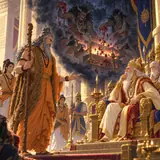
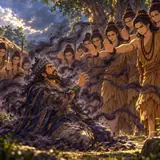
Scene 4 of 16 · Kaikeyi claims her two boons, and King Dasharatha, bound by his word, sends Rama away.
पूर्वं दत्तवरा देवी वरमेनमयाचत । विवासनञ्च रामस्य भरतस्याभिषेचनम् ॥ २२ ॥
“the queen to whom boons had been granted long before, asked for these as her boons: Rama’s exile and Bharata’s consecration.
“जिन्हें बहुत पहले वर दिए जा चुके थे, वे वर माँगे: राम का वनवास और भरत का अभिषेक।
CommentaryNot scripture One short verse carries the whole crisis. Kaikeyi’s boons were granted long before (datta-vara ), in a battle where she saved Dasharatha’s life; the Ayodhya Kanda tells it. Narada does not judge her here. He states the two requests flatly: Rama’s exile, Bharata’s crowning. The calm voice makes the blow heavier. A happy coronation turns to exile in a single line.
Scene 4 of 16 · Kaikeyi claims her two boons, and King Dasharatha, bound by his word, sends Rama away.
स सत्यवचनाद्राजा धर्मपाशेन संयतः । विवासयामास सुतं रामं दशरथः प्रियम् ॥ २३ ॥
“Bound by his word and held by the noose of dharma, King Dasharatha sent his beloved son Rama into exile.
“अपने वचन से बँधे और धर्म के पाश में जकड़े हुए राजा दशरथ ने अपने प्रिय पुत्र राम को वन भेज दिया।
CommentaryNot scripture Dharma-pasha , “the noose of dharma”, is a striking image. Dasharatha is caught by his own word. A king who breaks a promise breaks the ground his rule stands on, so the very virtue that makes him a good king now forces him to lose his son. This is the Ramayana’s first great tragedy: goodness trapped by goodness.
Scene 4 of 16 · Kaikeyi claims her two boons, and King Dasharatha, bound by his word, sends Rama away.
स जगाम वनं वीरः प्रतिज्ञामनुपालयन् । पितुर्वचननिर्देशात् कैकेय्याः प्रियकारणात् ॥ २४ ॥
“The hero went to the forest, keeping the promise, at his father’s command and to please Kaikeyi.
“वीर राम पिता की आज्ञा से, कैकेयी को प्रसन्न करने के लिए और प्रतिज्ञा का पालन करते हुए वन को चले गए।
CommentaryNot scripture Three reasons are given for Rama’s going, and the order teaches. First the promise (pratijna ), which he makes his own though it was his father’s. Then his father’s command. Then, surprisingly, “to please Kaikeyi”. Rama does not leave in bitterness toward the queen who exiled him. He goes so that her wish is fulfilled. This is the heart of his character.
Scene 4 of 16 · Kaikeyi claims her two boons, and King Dasharatha, bound by his word, sends Rama away.
तं व्रजन्तं प्रियो भ्राता लक्ष्मणोऽनुजगाम ह । स्नेहाद् विनयसम्पन्नः सुमित्रानन्दवर्धनः ॥ २५ ॥
“As he went, his dear brother Lakshmana followed him out of love, full of humility, he who increases the joy of Sumitra,
“उनके जाते समय सुमित्रा का आनंद बढ़ाने वाले, विनय से भरे प्रिय भाई लक्ष्मण प्रेमवश उनके पीछे चल पड़े,
CommentaryNot scripture Lakshmana enters the poem with three marks: love (sneha ), humility (vinaya ), and the joy he gives his mother Sumitra. No one asks him to go. Nothing in the boons concerns him. He simply follows, and that choice will define him for fourteen years. In tradition he becomes the model of the devoted younger brother, the one who serves without being asked.
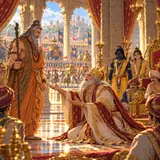
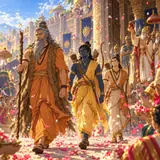
Scene 5 of 16 · Lakshmana and Sita follow Rama into exile, and all Ayodhya walks behind them.
भ्रातरं दयितो भ्रातुः सौभ्रात्रमनुदर्शयन् । रामस्य दयिता भार्या नित्यं प्राणसमा हिता ॥ २६ ॥
जनकस्य कुले जाता देवमायेव निर्मिता । सर्वलक्षणसम्पन्ना नारीणामुत्तमा वधूः ॥ २७ ॥
सीताप्यनुगता रामं शशिनं रोहिणी यथा । पौरैरनुगतो दूरं पित्रा दशरथेन च ॥ २८ ॥
“showing a brother’s devotion to the brother who loved him. And Rama’s beloved wife, always dear to him as his own life, born in the house of Janaka as if fashioned by divine art, endowed with every auspicious mark, the finest of women, Sita too followed Rama, as Rohini follows the moon. The citizens followed him far, and his father Dasharatha too.
“अपने स्नेही भाई के प्रति भ्रातृ-प्रेम दिखाते हुए। और राम की प्रिय पत्नी सीता भी, जो उन्हें प्राणों के समान सदा प्रिय थीं, जनक के कुल में जन्मी थीं मानो देवताओं की माया से रची गई हों, सब शुभ लक्षणों से युक्त और स्त्रियों में श्रेष्ठ थीं, राम के पीछे वैसे ही चलीं जैसे रोहिणी चंद्रमा के पीछे चलती है। नगरवासी और पिता दशरथ भी दूर तक उनके पीछे गए।
CommentaryNot scripture Sita is described as if made by divine art (deva-maya ), and devotees read this as a hint that she was born from the earth, not from a mother. The simile is beautiful: she follows Rama as Rohini, the star, follows the moon across the night sky. Never apart, always close. And the whole city follows too, with the old king himself, unable to let him go.
Scene 5 of 16 · Lakshmana and Sita follow Rama into exile, and all Ayodhya walks behind them.
शृङ्गवीरपुरे सूतं गङ्गाकूले व्यसर्जयत् । गुहमासाद्य धर्मात्मा निषादाधिपतिं प्रियम् ॥ २९ ॥
“At Shringaverapura, on the bank of the Ganga, he sent back the charioteer. Coming to Guha, the beloved lord of the Nishadas, the righteous one,
“गंगा के तट पर शृंगवेरपुर में उन्होंने सारथी को लौटा दिया। निषादों के प्रिय राजा गुह के पास पहुँचकर धर्मात्मा राम,
CommentaryNot scripture Shringaverapura, on the Ganga, is where Rama sends the chariot back: the last link to royal life breaks here. Then comes Guha, king of the Nishadas, a forest people. Narada calls him priya , dear. Rama’s friendship with Guha is the first sign of the quality praised in verse 16: he is equal toward all, and a tribal chief is his beloved friend.
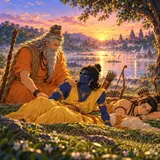
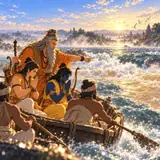
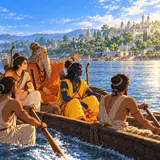
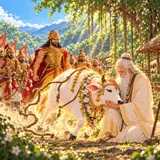
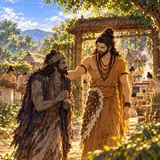
Scene 6 of 16 · Guha ferries them over the Ganga; they make their home at Chitrakuta.
गुहेन सहितो रामो लक्ष्मणेन च सीतया । ते वनेन वनङ्गत्वा नदीस्तीर्त्वा बहूदकाः ॥ ३० ॥
चित्रकूटमनुप्राप्य भरद्वाजस्य शासनात् । रम्यमावसथं कृत्वा रममाणा वने त्रयः ॥ ३१ ॥
“with Guha, Lakshmana and Sita, passed from forest to forest and crossed rivers full of water, and on Bharadvaja’s advice reached Chitrakuta. There the three made a pleasant dwelling and delighted in the forest.
“गुह, लक्ष्मण और सीता के साथ वन से वन होते हुए, जल से भरी नदियाँ पार करके, भरद्वाज के कहने पर चित्रकूट पहुँचे। वहाँ तीनों ने सुंदर कुटी बनाई और वन में आनंद से रहने लगे।
CommentaryNot scripture The journey is told in the plural: forests, rivers full of water. Bharadvaja, the great sage of Prayaga, shows them the way to Chitrakuta, the “many-peaked” hill. There “the three” make a home. Exile is not shown only as suffering. They delight in the forest (remire ). Valmiki lets this short season of happiness shine before the darkness comes.
Scene 6 of 16 · Guha ferries them over the Ganga; they make their home at Chitrakuta.
देवगन्धर्वसंकाशाः तत्र ते न्यवसन् सुखम् । चित्रकूटङ्गते रामे पुत्रशोकातुरस्तथा ॥ ३२ ॥
राजा दशरथस्स्वर्गं जगाम विलपन् सुतम् । गते तु तस्मिन् भरतो वसिष्ठप्रमुखैर्द्विजैः ॥ ३३ ॥
“Like gods or gandharvas, they lived there happily. When Rama had gone to Chitrakuta, King Dasharatha, stricken with grief for his son, went to heaven lamenting him. When he was gone, Bharata was urged by Vasishtha and the other brahmanas
“देवताओं और गंधर्वों की तरह वे वहाँ सुख से रहे। राम के चित्रकूट चले जाने पर पुत्र के शोक से पीड़ित राजा दशरथ उनके लिए विलाप करते हुए स्वर्ग सिधार गए। उनके जाने के बाद वसिष्ठ आदि ब्राह्मणों ने भरत से
CommentaryNot scripture “Like gods or gandharvas”: the three live in the forest like celestial beings. Then the contrast is sharp. In Ayodhya the old king dies of grief, crying for his son. Dasharatha’s death fulfils an old curse from his youth, told later in the Ayodhya Kanda. Vasishtha, the family priest, must now find a king, and he turns to Bharata.
Scene 6 of 16 · Guha ferries them over the Ganga; they make their home at Chitrakuta.
नियुज्यमानो राज्याय नैच्छत् राज्यं महाबलः । स जगाम वनं वीरो रामपादप्रसादकः ॥ ३४ ॥
“to take up the kingdom, but the mighty one did not want the kingdom. The hero went to the forest to seek Rama’s grace at his feet.
“राज्य संभालने को कहा, पर महाबली भरत ने राज्य नहीं चाहा। वे वीर राम के चरणों में कृपा माँगने वन को चल पड़े।
CommentaryNot scripture Bharata refuses the throne his mother won for him. Notice the word mahabala , mighty: Narada stresses his strength so that his refusal is seen as choice, not weakness. He goes to the forest prasada-artham , to seek Rama’s grace. Bharata’s love for Rama is one of the purest things in the poem, and here it shines for the first time.
Scene 7 of 16 · Bharata begs Rama to return and carries his sandals back to rule in his name.
गत्वा तु स महात्मानं रामं सत्यपराक्रमम् । अयाचद्भ्रातरं रामम् आर्यभावपुरस्कृतः ॥ ३५ ॥
“Reaching the great-souled Rama, whose prowess is truth, he begged his brother, putting his own nobility before him:
“सत्य-पराक्रमी महात्मा राम के पास पहुँचकर उन्होंने अपनी विनम्रता सामने रखते हुए अपने भाई से याचना की:
CommentaryNot scripture Bharata “puts his own nobility before him” (puraskritya mahatmanam ): he comes as a humble petitioner, not a rival. Some readers take the phrase to mean he came with the elders and the citizens in front of him. Either way, the scene is one of the most moving in Indian literature: two brothers each trying to give the kingdom to the other.
Scene 7 of 16 · Bharata begs Rama to return and carries his sandals back to rule in his name.
त्वमेव राजा धर्मज्ञ इति रामं वचोऽब्रवीत् । रामोऽपि परमोदारः सुमुखस्सुमहायशाः ॥ ३६ ॥
न चैच्छत् पितुरादेशात् राज्यं रामो महाबलः । पादुके चास्य राज्याय न्यासं दत्त्वा पुनः पुनः ॥ ३७ ॥
“’You alone are king, knower of dharma,’ he said to Rama. But Rama, most generous, gracious of face and greatly renowned, would not take the kingdom, because of his father’s command. Giving his sandals again and again as a pledge for the kingdom,
“’धर्म के ज्ञाता, आप ही राजा हैं,’ उन्होंने राम से कहा। पर परम उदार, प्रसन्न-मुख और महायशस्वी राम ने पिता की आज्ञा के कारण राज्य स्वीकार नहीं किया। राज्य की धरोहर के रूप में बार-बार अपनी पादुकाएँ देकर
CommentaryNot scripture “You alone are king.” Bharata’s plea is simple and complete. Rama’s refusal is just as simple: his father’s command. Then the famous gift: the sandals (paduka ), given as a pledge, a stand-in for the true king. The words “again and again” suggest the long argument, the many embraces and tears. The sandals become the most loved symbol of the Ayodhya Kanda.
Scene 7 of 16 · Bharata begs Rama to return and carries his sandals back to rule in his name.
निवर्तयामास ततो भरतं भरताग्रजः । स काममनवाप्यैव रामपादावुपस्पृशन् ॥ ३८ ॥
“Bharata’s elder brother sent Bharata back. Bharata, his wish unfulfilled, touched Rama’s feet,
“भरत के बड़े भाई ने भरत को लौटा दिया। मनोरथ पूरा न होने पर भरत ने राम के चरण छुए,
CommentaryNot scripture Akamah , “his wish unfulfilled”: Bharata leaves without what he came for. Yet he does not argue further. He touches Rama’s feet, a gesture of total respect. In the full story he vows to live as an ascetic outside the city until Rama returns. Narada gives only the touch of the feet, and that is enough.
Scene 7 of 16 · Bharata begs Rama to return and carries his sandals back to rule in his name.
नन्दिग्रामेऽकरोद् राज्यं रामागमनकाङ्क्षया । गते तु भरते श्रीमान् सत्यसन्धो जितेन्द्रियः ॥ ३९ ॥
“and ruled the kingdom from Nandigrama, longing for Rama’s return. When Bharata had gone, the glorious Rama, true to his word and master of his senses,
“और राम के लौटने की प्रतीक्षा करते हुए नंदीग्राम से राज्य चलाने लगे। भरत के चले जाने पर सत्यप्रतिज्ञ, जितेंद्रिय और यशस्वी राम ने,
CommentaryNot scripture Nandigrama is a village near Ayodhya. Bharata rules from there, not from the palace, and in the full story he sets Rama’s sandals on the throne and acts only as their servant. Rama-agamana-kankshaya : “longing for Rama’s return”. For fourteen years his whole reign is a waiting. Then the camera turns back to Rama.
Scene 7 of 16 · Bharata begs Rama to return and carries his sandals back to rule in his name.
रामस्तु पुनरालक्ष्य नागरस्य जनस्य च । तत्रागमनमेकाग्रो दण्डकान् प्रविवेश ह ॥ ४० ॥
“foreseeing that the citizens and others would come to him there again, with a single mind entered the Dandaka forest.
“यह सोचकर कि नगरवासी और दूसरे लोग फिर यहाँ आएँगे, एकाग्र मन से दंडक वन में प्रवेश किया।
CommentaryNot scripture Why does Rama leave Chitrakuta? Because people from Ayodhya will keep coming, and their grief and love would hold him back. Ananya-manah , “with a single mind”, he goes deeper into the wild Dandaka forest. This is the true start of the forest years: Rama chooses solitude to keep his vow whole.
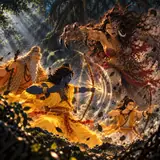
Scene 8 of 16 · In the Dandaka forest Rama vows to protect the sages and defeats Khara’s army.
प्रविश्य तु महारण्यं रामो राजीवलोचनः । विराधं राक्षसं हत्वा शरभङ्गं ददर्श ह ॥ ४१ ॥
“Entering the great forest, lotus-eyed Rama killed the rakshasa Viradha and saw Sharabhanga,
“उस महावन में प्रवेश करके कमल-नयन राम ने विराध राक्षस को मारा और शरभंग,
CommentaryNot scripture The Dandaka forest at once brings danger and grace. Viradha, a huge rakshasa who tries to seize Sita, is the first demon Rama kills in exile. Sharabhanga is an old sage who waits for Rama before leaving his body. Danger and holiness meet in the same forest; that is the world of the Aranya Kanda.
Scene 8 of 16 · In the Dandaka forest Rama vows to protect the sages and defeats Khara’s army.
सुतीक्ष्णं चाप्यगस्त्यं च अगस्त्यभ्रातरं तथा । अगस्त्यवचनाच्चैव जग्राहैन्द्रं शरासनम् ॥ ४२ ॥
खड्गञ्च परम प्रीतस्तूणी चाक्षयसायकौ । वसतस्तस्य रामस्य वने वनचरैः सह ॥ ४३ ॥
“Sutikshna, Agastya and Agastya’s brother. At Agastya’s word, deeply pleased, he received the bow of Indra, a sword, and two quivers whose arrows never run out. While Rama lived in the forest among its creatures,
“सुतीक्ष्ण, अगस्त्य और अगस्त्य के भाई के दर्शन किए। अगस्त्य के कहने पर उन्होंने बड़े हर्ष से इंद्र का धनुष, एक तलवार और कभी खाली न होने वाले बाणों से भरे दो तरकश ग्रहण किए। जब राम वन के प्राणियों के बीच रह रहे थे,
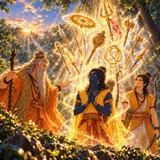
CommentaryNot scripture Agastya is the greatest of the southern sages, the one who once drank the ocean. His gifts arm Rama for what is coming: Indra’s bow, a sword, and two quivers that never run empty (akshaya ). The gift of weapons from a sage is a quiet signal. A war is ahead, and heaven itself is equipping its champion.
Scene 8 of 16 · In the Dandaka forest Rama vows to protect the sages and defeats Khara’s army.
ऋषयोऽभ्यागमन् सर्वे वधायासुररक्षसाम् । स तेषां प्रतिशुश्राव राक्षसानां तदा वने ॥ ४४ ॥
“all the sages came to him for the killing of asuras and rakshasas. He promised them then, there in the forest,
“तब सब ऋषि असुरों और राक्षसों के वध की प्रार्थना लेकर उनके पास आए। उन्होंने वहीं वन में उन्हें वचन दिया,
CommentaryNot scripture The sages come “for the killing of asuras and rakshasas”. Living in the forest, they have been preyed upon for years; the Aranya Kanda shows a heap of their bones. They have no army, so they come to the one prince who has entered the forest. Their plea turns Rama’s exile into a mission.
Scene 8 of 16 · In the Dandaka forest Rama vows to protect the sages and defeats Khara’s army.
प्रतिज्ञातश्च रामेण वधः संयति रक्षसाम् । ऋषीणामग्निकल्पानां दण्डकारण्यवासीनाम् ॥ ४५ ॥
“and Rama vowed to slay the rakshasas in battle, for the sake of the fire-like sages who lived in the Dandaka forest.
“और दंडक वन में रहने वाले अग्नि के समान तेजस्वी ऋषियों के लिए राम ने युद्ध में राक्षसों को मारने की प्रतिज्ञा की।
CommentaryNot scripture Pratijna , a vow, appears again. Rama promised his father to go to the forest; now he promises the sages to protect them. The sages are called “like fire” (agni-kalpa ), shining with the power of their austerity. Yet they need a protector, because a sage must not use his power in anger. Rama becomes the sword they do not carry.
Scene 8 of 16 · In the Dandaka forest Rama vows to protect the sages and defeats Khara’s army.
तेन तत्रैव वसता जनस्थाननिवासिनी । विरूपिता शूर्पणखा राक्षसी कामरूपिणी ॥ ४६ ॥
“While he lived there, Shurpanakha, a rakshasi who could take any form and who dwelt in Janasthana, was disfigured by him.
“वहाँ रहते हुए उन्होंने जनस्थान में रहने वाली, इच्छा से रूप बदलने वाली राक्षसी शूर्पणखा को विरूप कर दिया।
CommentaryNot scripture Shurpanakha, Ravana’s sister, is the spark that lights the war. Narada says only that she was disfigured (virupita ); in the full story Lakshmana cuts off her nose and ears after she attacks Sita. Kama-rupini , “able to take any form”, is a mark of rakshasa power. From this one verse the whole conflict with Lanka begins.
Scene 8 of 16 · In the Dandaka forest Rama vows to protect the sages and defeats Khara’s army.
ततः शूर्पणखावाक्यादुद्युक्तान् सर्वराक्षसान् । खरं त्रिशिरसं चैव दूषणं चैव राक्षसम् ॥ ४७ ॥
निजघान रणे रामस्तेषां चैव पदानुगान् । वने तस्मिन् निवसता जनस्थाननिवासिनाम् ॥ ४८ ॥
रक्षसां निहतान्यासन् सहस्राणि चतुर्दश । ततो ज्ञातिवधं श्रुत्वा रावणः क्रोधमूर्छितः ॥ ४९ ॥
“Then, roused by Shurpanakha’s words, all the rakshasas came against him: Khara, Trishiras and the rakshasa Dushana. Rama slew them in battle, with all their followers. While he lived in that forest, fourteen thousand of the rakshasas who dwelt in Janasthana were killed. Hearing of the slaughter of his kin, Ravana, faint with rage,
“तब शूर्पणखा के उकसाने पर सब राक्षस उन पर चढ़ आए: खर, त्रिशिरा और राक्षस दूषण। राम ने उन्हें उनके सब अनुयायियों सहित युद्ध में मार डाला। उस वन में रहते हुए उन्होंने जनस्थान के चौदह हज़ार राक्षसों का संहार किया। अपने कुल के इस संहार को सुनकर रावण क्रोध से मूर्च्छित-सा हो गया,
CommentaryNot scripture Khara, Dushana and Trishiras lead fourteen thousand rakshasas, and Rama defeats them alone (in the full story Lakshmana guards Sita in a cave). The number is meant to astonish. Then the news reaches Lanka. Krodha-murchita : Ravana is “faint with rage”. A ruler who is driven by anger is the opposite of the man described in verse 4.
Scene 8 of 16 · In the Dandaka forest Rama vows to protect the sages and defeats Khara’s army.
सहायं वरयामास मारीचं नाम राक्षसम् । वार्यमाणः सुबहुशो मारीचेन स रावणः ॥ ५० ॥
“chose as his helper a rakshasa named Maricha. Though Maricha warned him again and again,
“और उसने मारीच नाम के राक्षस को अपना सहायक चुना। मारीच ने उसे बार-बार रोका,
CommentaryNot scripture Maricha is an old enemy of Rama; in the Bala Kanda we will see the boy Rama strike him with an arrow that throws him into the sea. He knows Rama’s power from experience. That is why he warns Ravana “again and again”. The one who knows best is the one who is not heard.
Scene 9 of 16 · Ravana uses Maricha’s illusion, kills Jatayu and carries Sita away.
न विरोधो बलवता क्षमो रावण तेन ते । अनादृत्य तु तद्वाक्यं रावणः कालचोदितः ॥ ५१ ॥
“’Ravana, you are not able to take on one so mighty,’ Ravana ignored his words and, driven by fate,
“’रावण, इतने बलवान से भिड़ना तुम्हारे बस का नहीं,’ पर काल से प्रेरित रावण ने उसकी बात अनसुनी कर दी,
CommentaryNot scripture Maricha’s warning is a single, clear line: you are not able to fight him. Ravana ignores it, “driven by fate” (kala-codita ). In the epics kala , time or fate, drives those who are about to fall. Wisdom was offered. Ravana chose not to listen, and the poem lets us feel that this refusal seals his doom.
Scene 9 of 16 · Ravana uses Maricha’s illusion, kills Jatayu and carries Sita away.
जगाम सहमारीचस्तस्याश्रमपदं तदा । तेन मायाविना दूरमपवाह्य नृपात्मजौ ॥ ५२ ॥
जहार भार्यां रामस्य गृध्रं हत्वा जटायुषम् । गृध्रञ्च निहतं दृष्ट्वा हृतां श्रुत्वा च मैथिलीम् ॥ ५३ ॥
“went with Maricha to Rama’s hermitage. Through that master of illusion he lured the two princes far away and carried off Rama’s wife, after killing the vulture Jatayu. Seeing the vulture slain and hearing that Maithili had been taken,
“और मारीच के साथ राम के आश्रम पहुँचा। उस मायावी के द्वारा दोनों राजकुमारों को दूर ले जाकर, गिद्ध जटायु को मारकर, उसने राम की पत्नी का हरण कर लिया। गिद्ध को मरा देखकर और मैथिली के हरण का समाचार सुनकर,
CommentaryNot scripture The golden deer is not named here, only the “master of illusion” (mayavin ) who lures the brothers away. Then the theft of Sita, and Jatayu, the old vulture king, who fights Ravana and falls. Jatayu is a bird who gives his life for dharma. Through this poem, birds and animals often prove nobler than kings.
Scene 9 of 16 · Ravana uses Maricha’s illusion, kills Jatayu and carries Sita away.
राघवः शोकसंतप्तो विललापाकुलेन्द्रियः । ततस्तेनैव शोकेन गृध्रं दग्ध्वा जटायुषम् ॥ ५४ ॥
मार्गमाणो वने सीतां राक्षसं सन्ददर्श ह । कबन्धं नाम रूपेण विकृतं घोरदर्शनम् ॥ ५५ ॥
“Raghava, burning with grief, wept with all his senses shaken. Then, in that same grief, he cremated the vulture Jatayu, and searching the forest for Sita he came upon a rakshasa named Kabandha, misshapen in form and terrible to see.
“राघव शोक से जलते हुए, सब इंद्रियों के व्याकुल होने से रो पड़े। उसी शोक में उन्होंने गिद्ध जटायु का दाह-संस्कार किया, और सीता को वन में खोजते हुए कबंध नाम के राक्षस से मिले, जो विकृत रूप वाला और देखने में भयानक था।
CommentaryNot scripture Rama weeps. The perfect hero of verses 8 to 18 is not a stone. Vyakulendriya , all his senses shaken: his grief is complete and human. Yet even in grief he does his duty: he cremates Jatayu as a son would cremate a father. Then Kabandha, a headless monster with a mouth in his belly, rises in the search.
Scene 10 of 16 · Rama grieves, frees Kabandha and is honoured by Shabari.
तन्निहत्य महाबाहुर्ददाह स्वर्गतश्च सः । स चास्य कथयामास शबरीं धर्मचारिणीम् ॥ ५६ ॥
श्रमणां धर्मनिपुणामभिगच्छेति राघव । सोऽभ्य गच्छन्महातेजाः शबरीं शत्रुसूदनः ॥ ५७ ॥
“The mighty-armed one killed him and cremated him, and Kabandha rose to heaven. Before he went he told him: ‘Raghava, go to Shabari, the ascetic who walks in dharma and is skilled in it.’ The radiant slayer of enemies went to Shabari,
“महाबाहु राम ने उसे मारकर उसका दाह-संस्कार किया, और कबंध स्वर्ग चला गया। जाते समय उसने कहा: ‘राघव, धर्म का पालन करने वाली और धर्म में निपुण तपस्विनी शबरी के पास जाइए।’ शत्रुओं का नाश करने वाले तेजस्वी राम शबरी के पास गए,
CommentaryNot scripture Killing Kabandha frees him: he was a gandharva under a curse, and the fire of his cremation returns him to heaven. A slain enemy becomes a guide. His advice sends Rama to Shabari. In this poem even demons can be released, and Rama’s arrows heal as often as they destroy.
Scene 10 of 16 · Rama grieves, frees Kabandha and is honoured by Shabari.
शबर्या पूजितः सम्यग् रामो दशरथात्मजः । पम्पातीरे हनुमता सङ्गतो वानरेण ह ॥ ५८ ॥
“and Rama, son of Dasharatha, was honoured by her with full reverence. On the bank of the Pampa he met the vanara Hanuman,
“और दशरथ-पुत्र राम का शबरी ने पूरे आदर से सत्कार किया। पंपा के तट पर उनकी भेंट वानर हनुमान से हुई,
CommentaryNot scripture Shabari is an old woman of a forest tribe, a disciple of the sage Matanga, who has waited years to see Rama. She honours him with full reverence (samyak pujitah ). Later devotion loves the tale of the berries she tasted first; that tale is not in Valmiki. Here her worship is enough. Then, on the banks of Pampa, Hanuman appears.
Scene 10 of 16 · Rama grieves, frees Kabandha and is honoured by Shabari.
हनुमद्वचनाच्चैव सुग्रीवेण समागतः । सुग्रीवाय च तत्सर्वं शंसद्रामो महाबलः ॥ ५९ ॥
आदितस्तद् यथावृत्तं सीतायाश्च विशेषतः । सुग्रीवश्चापि तत्सर्वं श्रुत्वा रामस्य वानरः ॥ ६० ॥
“and at Hanuman’s word he joined Sugriva. Mighty Rama told Sugriva everything that had happened from the beginning, and above all about Sita. Hearing all of Rama’s story, the vanara Sugriva
“और हनुमान के कहने पर वे सुग्रीव से मिले। महाबली राम ने सुग्रीव को आरंभ से सब कुछ बताया, विशेषकर सीता के बारे में। राम की पूरी कथा सुनकर वानर सुग्रीव ने
CommentaryNot scripture Hanuman’s first act in the poem is to bring two people together. He is a minister of Sugriva, and his speech is so wise that Rama praises it in the Kishkindha Kanda. Rama tells his whole story to a stranger, a vanara, holding nothing back. Trust is the first thing that passes between them.
Scene 11 of 16 · Hanuman brings Rama to Sugriva; with one arrow Rama pierces seven sala trees.
चकार सख्यं रामेण प्रीतश्चैवाग्निसाक्षिकम् । ततो वानरराजेन वैरानुकथनं प्रति ॥ ६१ ॥
रामायावेदितं सर्वं प्रणयात् दुःखितेन च । प्रतिज्ञातञ्च रामेण तदा वालिवधं प्रति ॥ ६२ ॥
“gladly made friendship with Rama, with fire as witness. Then the king of the vanaras, grieving, told Rama everything about his feud, out of trust. And Rama promised then to kill Vali.
“प्रसन्न होकर अग्नि को साक्षी मानकर राम से मित्रता की। फिर वानरों के राजा ने दुखी होकर विश्वासपूर्वक अपने वैर की सारी बात राम को बताई। और राम ने तभी वाली को मारने का वचन दिया।
CommentaryNot scripture The friendship is sealed “with fire as witness” (agni-sakshika ), the same rite that witnesses a marriage. That shows how serious it is. Sugriva, exiled by his brother Vali, tells his own story. Two exiled princes, each robbed of a wife, recognise each other. Rama’s promise to kill Vali comes out of that shared pain.
Scene 11 of 16 · Hanuman brings Rama to Sugriva; with one arrow Rama pierces seven sala trees.
वालिनश्च बलं तत्र कथयामास वानरः । सुग्रीवः शङ्कितश्चासीन्नित्यं वीर्येण राघवे ॥ ६३ ॥
“The vanara told him there of Vali’s strength, for Sugriva was always doubtful about Raghava’s power.
“वानर ने वहाँ वाली के बल का वर्णन किया, क्योंकि सुग्रीव को राघव के बल पर सदा संदेह बना रहता था।
CommentaryNot scripture Sugriva doubts (shankita ). He has seen Vali’s strength up close and cannot believe a slender young man in bark cloth can match it. Narada does not hide this doubt. Faith is not assumed in the Ramayana; it has to be earned, even by Rama.
Scene 11 of 16 · Hanuman brings Rama to Sugriva; with one arrow Rama pierces seven sala trees.
राघवप्रत्ययार्थं तु दुन्दुभेः कायमुत्तमम् । दर्शयामास सुग्रीवः महापर्वतसन्निभम् ॥ ६४ ॥
“To give himself confidence in Raghava, Sugriva showed him the great body of Dundubhi, huge as a mountain.
“राघव पर विश्वास जमाने के लिए सुग्रीव ने उन्हें पर्वत जैसा विशाल दुंदुभि का शरीर दिखाया।
CommentaryNot scripture Dundubhi was a buffalo-shaped demon that Vali killed and hurled across the forest; its huge skeleton still lies there like a hill. Sugriva shows it as a measure: this is what Vali can do. The test is honest. Sugriva needs to know if his new friend can really win.
Scene 11 of 16 · Hanuman brings Rama to Sugriva; with one arrow Rama pierces seven sala trees.
उत्स्मयित्वा महाबाहुः प्रेक्ष्य चास्ति महाबलः । पादाङ्गुष्ठेन चिक्षेप संपूर्णं दशयोजनम् ॥ ६५ ॥
“The mighty-armed one smiled, looked at it, and with his big toe flung the whole carcass ten yojanas.
“महाबाहु राम ने मुस्कराकर उसे देखा और पैर के अँगूठे से उस पूरे शरीर को दस योजन दूर फेंक दिया।
CommentaryNot scripture “He smiled.” A single word reveals Rama’s ease. With his big toe alone he flings the skeleton ten yojanas, a huge distance. The comic grace of the moment matters: Rama does not boast or strain. Power held lightly is the mark of the one Narada described as self-controlled.
Scene 11 of 16 · Hanuman brings Rama to Sugriva; with one arrow Rama pierces seven sala trees.
बिभेद च पुनस्सालान् सप्तैकेन महेषुणा । गिरिं रसातलञ्चैव जनयन् प्रत्ययं तथा ॥ ६६ ॥
“And with one great arrow he pierced seven sala trees, and the hill behind them, and even the underworld, giving him proof.
“और एक ही महाबाण से उन्होंने सात साल वृक्षों को, उनके पीछे के पर्वत को और रसातल तक को भेद दिया, जिससे सुग्रीव को विश्वास हो गया।
CommentaryNot scripture The seven sala trees stand in a row, and one arrow passes through all seven, through the hill behind them and down into the underworld. The arrow returns to his quiver in the full story. This is the moment Sugriva’s doubt ends. Pratyayam , proof: Rama gives the evidence his friend needs.
Scene 11 of 16 · Hanuman brings Rama to Sugriva; with one arrow Rama pierces seven sala trees.
ततः प्रीतमनास्तेन विश्वस्तस्स महाकपिः । किष्किन्धां रामसहितो जगाम च गुहां तदा ॥ ६७ ॥
“Then, glad at heart and trusting him, the great vanara went with Rama to the cave of Kishkindha.
“तब मन में प्रसन्न और विश्वास से भरा महाकपि राम के साथ किष्किंधा की गुफा की ओर चला।
CommentaryNot scripture Prita-mana , glad at heart, and vishvasta , trusting: Sugriva has changed in a single scene. Now he walks with Rama to Kishkindha, the cave-city of the vanaras. The word “cave” (guha ) is real: Kishkindha is a city built in a vast mountain cavern.
Scene 11 of 16 · Hanuman brings Rama to Sugriva; with one arrow Rama pierces seven sala trees.
ततोऽगर्जद्धरिवरः सुग्रीवो हेमपिङ्गलः । तेन नादेन महता निर्जगाम हरीश्वरः ॥ ६८ ॥
अनुमान्य तदा तारां सुग्रीवेण समागतः । निजघान च तत्रैनं शरेणैकेन राघवः ॥ ६९ ॥
“Then Sugriva, best of the vanaras, tawny as gold, roared, and at that great roar the lord of the vanaras came out, after taking leave of Tara, and met Sugriva. There Raghava killed him with a single arrow.
“वहाँ स्वर्ण जैसे पीले रंग के वानरश्रेष्ठ सुग्रीव ने गर्जना की, और उस महानाद को सुनकर वानरों का स्वामी तारा से विदा लेकर बाहर निकला और सुग्रीव से भिड़ गया। वहाँ राघव ने उसे एक ही बाण से मार डाला।
CommentaryNot scripture Sugriva roars a challenge, and Vali comes out after taking leave of Tara, his wise queen, who had tried to stop him. Rama kills Vali with one arrow. Narada does not mention that Rama shot from hiding; the Kishkindha Kanda raises that question openly and lets Vali himself ask it. The summary simply moves on.
Scene 11 of 16 · Hanuman brings Rama to Sugriva; with one arrow Rama pierces seven sala trees.
ततः सुग्रीववचनात् हत्वा वालिनमाहवे । सुग्रीवमेव तद्राज्ये राघवः प्रत्यपादयत् ॥ ७० ॥
“So, at Sugriva’s word, having slain Vali in combat, Raghava gave that kingdom to Sugriva.
“इस प्रकार सुग्रीव के कहने पर युद्ध में वाली को मारकर राघव ने वह राज्य सुग्रीव को दे दिया।
CommentaryNot scripture Rama does not take Kishkindha for himself. He gives the kingdom to Sugriva, just as he will later give Lanka to Vibhishana. Rama never conquers to rule. Each war he fights ends with a kingdom handed to its rightful heir.
Scene 11 of 16 · Hanuman brings Rama to Sugriva; with one arrow Rama pierces seven sala trees.
स च सर्वान् समानीय वानरान् वानरर्षभः । दिशः प्रस्थापयामास दिदृक्षुर्जनकात्मजाम् ॥ ७१ ॥
“That bull among vanaras assembled all the vanaras and sent them out in every direction, eager to find the daughter of Janaka.
“उस वानरश्रेष्ठ ने सब वानरों को इकट्ठा किया और जनक की पुत्री को खोजने के लिए उन्हें सब दिशाओं में भेजा।
CommentaryNot scripture The search begins. Sugriva sends vanaras in every direction (dishah ) to find Sita; the Kishkindha Kanda lists the lands of the whole known world in that search. Note the purpose: “eager to find the daughter of Janaka”. The entire vanara nation now works for one woman’s freedom.
Scene 12 of 16 · Hanuman leaps the ocean, finds Sita in the ashoka grove and sets Lanka ablaze.
ततो गृध्रस्य वचनात् संपातेर्हनुमान् बली । शतयोजनविस्तीर्णं पुप्लुवे लवणार्णवम् ॥ ७२ ॥
“Then, at the word of the vulture Sampati, mighty Hanuman leapt across the salt ocean, a hundred yojanas wide.
“तब गिद्ध संपाति के कहने पर बलवान हनुमान सौ योजन चौड़े खारे समुद्र को लाँघ गए।
CommentaryNot scripture Sampati is Jatayu’s elder brother, a vulture who lost his wings flying too close to the sun. With his far sight he sees Sita in Lanka. One brother died for Sita; the other points the way to her. Then the great leap: a hundred yojanas across the salt ocean, the most famous single moment of the Sundara Kanda.
Scene 12 of 16 · Hanuman leaps the ocean, finds Sita in the ashoka grove and sets Lanka ablaze.
तत्र लङ्कां समासाद्य पुरीं रावणपालिताम् । ददर्श सीतां ध्यायन्तीम् अशोकवनिकां गताम् ॥ ७३ ॥
“There, reaching the city of Lanka, ruled by Ravana, he saw Sita lost in thought, kept in the ashoka grove.
“वहाँ रावण की नगरी लंका पहुँचकर उन्होंने अशोक वाटिका में बंदी, चिंता में डूबी सीता को देखा।
CommentaryNot scripture Dhyayanti , “lost in thought”: Sita is found meditating, thinking only of Rama. The ashoka grove, whose name means “without sorrow”, holds the most sorrowful prisoner in the poem. Valmiki’s word choices often carry this quiet irony.
Scene 12 of 16 · Hanuman leaps the ocean, finds Sita in the ashoka grove and sets Lanka ablaze.
निवेदयित्वाभिज्ञानं प्रवृत्तिं विनिवेद्य च । समाश्वास्य च वैदेहीं मर्दयामास तोरणम् ॥ ७४ ॥
“He gave her the token of recognition and told her all the news, comforted Vaidehi, and then smashed the grove’s gate.
“उन्होंने सीता को पहचान का चिह्न दिया, सारा समाचार सुनाया, वैदेही को धीरज बँधाया और फिर वाटिका का द्वार तोड़ डाला।
CommentaryNot scripture The token (abhijnana ) is Rama’s signet ring, proof that Hanuman comes from him. Hanuman comforts her first. Only after she is consoled does he turn warrior and smash the gate of the grove. The order is the lesson: kindness first, force second.
Scene 12 of 16 · Hanuman leaps the ocean, finds Sita in the ashoka grove and sets Lanka ablaze.
पञ्च सेनाग्रगान् हत्वा सप्त मन्त्रिसुतानपि । शूरमक्षं च निष्पिष्य ग्रहणं समुपागमत् ॥ ७५ ॥
“He killed five generals and seven sons of ministers, crushed the hero Aksha, and then allowed himself to be captured.
“उन्होंने पाँच सेनापतियों और मंत्रियों के सात पुत्रों को मारा, वीर अक्षकुमार को कुचल डाला और फिर स्वयं को पकड़ा जाने दिया।
CommentaryNot scripture Hanuman defeats generals and ministers’ sons, and kills Aksha, Ravana’s young son. Then the surprise: he lets himself be captured (grahanam upagamat ). He wants to see Ravana face to face and speak to him. A prisoner by choice is never really a prisoner.
Scene 12 of 16 · Hanuman leaps the ocean, finds Sita in the ashoka grove and sets Lanka ablaze.
अस्त्रेणोन्मुक्तमात्मानं ज्ञात्वा पैतामहाद् वरात् । मर्षयन् राक्षसान् वीरो यन्त्रिणस्तान् यदृच्छया ॥ ७६ ॥
ततो दग्ध्वा पुरीं लङ्काम् ऋते सीताञ्च मैथिलीम् । रामाय प्रियमाख्यातुं पुनरायान्महाकपिः ॥ ७७ ॥
“Knowing that, by Brahma’s boon, he was free of the weapon that bound him, the hero bore with the rakshasas who dragged him in ropes, as it suited him. Then, having burnt the city of Lanka, all except Sita the princess of Mithila, the great vanara came back to give Rama the good news.
“ब्रह्मा के वर से यह जानते हुए कि वे बाँधने वाले अस्त्र से मुक्त हैं, उस वीर ने अपनी इच्छा से रस्सियों में घसीटने वाले राक्षसों को सहन किया। फिर मिथिला की राजकुमारी सीता को छोड़कर पूरी लंका नगरी को जलाकर वह महाकपि राम को शुभ समाचार देने लौट आए।
CommentaryNot scripture Indrajit’s weapon of Brahma binds Hanuman, but a boon from Brahma means it cannot hold him long. He knows he is free, yet he lets the rakshasas drag him in ropes, “as it suited him”. Then he sets Lanka on fire with his own burning tail, sparing only the place where Sita sits. The fire that harms the city spares her.
Scene 12 of 16 · Hanuman leaps the ocean, finds Sita in the ashoka grove and sets Lanka ablaze.
सोऽभिगम्य महात्मानं कृत्वा रामं प्रदक्षिणम् । न्यवेदयदमेयात्मा दृष्टा सीतेति तत्त्वतः ॥ ७८ ॥
“Approaching great-souled Rama, the vanara of immeasurable spirit walked around him in reverence and told him exactly: ‘I have seen Sita.’
“महात्मा राम के पास पहुँचकर उस अपार आत्मबल वाले वानर ने उनकी परिक्रमा की और ठीक-ठीक बताया: ‘मैंने सीता को देखा है।’
CommentaryNot scripture Hanuman first walks around Rama in reverence (pradakshina ), then gives the news in the fewest possible words: “I have seen Sita” (drishta sita ). In the Sundara Kanda these two words come first so that Rama’s heart is eased before any detail. Hanuman’s speech is always as kind as it is clever.
Scene 12 of 16 · Hanuman leaps the ocean, finds Sita in the ashoka grove and sets Lanka ablaze.
ततः सुग्रीवसहितो गत्वा तीरं महोदधेः । समुद्रं क्षोभयामास शरैरादित्यसन्निभैः ॥ ७९ ॥
“Then, with Sugriva, Rama went to the shore of the great ocean and churned the sea with arrows bright as the sun.
“तब सुग्रीव के साथ राम महासागर के तट पर गए और सूर्य जैसे चमकते बाणों से समुद्र को क्षुब्ध कर दिया।
CommentaryNot scripture Rama’s arrows churn the ocean because the ocean will not let him pass. His patience had a limit: he waited and prayed first, as the Yuddha Kanda tells. The arrows are “bright as the sun” (aditya-samnibha ), and the sea itself begins to boil. Even nature must listen to dharma when it acts unjustly.
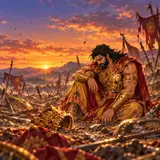
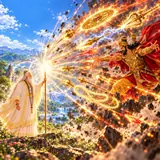
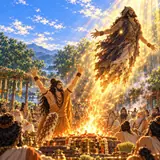
Scene 13 of 16 · The bridge, the war, and Sita’s ordeal by fire.
दर्शयामास चात्मानं समुद्रः सरितां पतिः । समुद्रवचनाच्चैव नलं सेतुमकारयत् ॥ ८० ॥
“The ocean, lord of rivers, revealed himself, and at the ocean’s word Rama had Nala build a bridge.
“नदियों के स्वामी समुद्र ने स्वयं प्रकट होकर दर्शन दिए, और समुद्र के कहने पर राम ने नल से सेतु बनवाया।
CommentaryNot scripture The ocean appears in person and offers a way: Nala, a vanara builder, can make a bridge. The bridge (setu ) across to Lanka is one of India’s best-known images, and the chain of shoals between India and Sri Lanka is still called Rama Setu in popular memory.
Scene 13 of 16 · The bridge, the war, and Sita’s ordeal by fire.
तेन गत्वा पुरीं लङ्कां हत्वा रावणमाहवे । रामः सीतामनुप्राप्य परां व्रीडामुपागमत् ॥ ८१ ॥
“By it he went to the city of Lanka and killed Ravana in battle. Having won Sita back, Rama felt deep shame.
“उस सेतु से लंका जाकर उन्होंने युद्ध में रावण को मारा। सीता को फिर पाकर राम को गहरी लज्जा हुई।
CommentaryNot scripture After the victory, a hard line: Rama feels vrida , shame. The word is debated. Some readers say he is ashamed of the public doubt about Sita; some say he is ashamed that he let her be taken. Valmiki leaves it unexplained. We should leave it there too, and read on.
Scene 13 of 16 · The bridge, the war, and Sita’s ordeal by fire.
तामुवाच ततो रामः परुषं जनसंसदि । अमृष्यमाणा सा सीता विवेश ज्वलनं सती ॥ ८२ ॥
“Then Rama spoke harshly to her in the assembly of people. Unable to bear it, the faithful Sita entered the fire.
“तब राम ने लोगों की सभा में सीता से कठोर वचन कहे। उन्हें सह न पाकर पतिव्रता सीता अग्नि में प्रवेश कर गईं।
CommentaryNot scripture Narada says it plainly: Rama spoke harshly (parusham ) to Sita in front of the people, and she, unable to bear it, entered the fire. This is one of the most painful moments in the poem, and Valmiki does not soften it. Sita is called sati , faithful, in the same line. The text is on her side.
Scene 13 of 16 · The bridge, the war, and Sita’s ordeal by fire.
ततोऽग्निवचनात् सीतां ज्ञात्वा विगतकल्मषाम् । कर्मणा तेन महता त्रैलोक्यं सचराचरम् ॥ ८३ ॥
सदेवर्षिगणं तुष्टं राघवस्य महात्मनः । बभौ रामः सम्प्रहृष्टः पूजितः सर्वदेवतैः ॥ ८४ ॥
“Then, at the word of Agni, Rama knew Sita to be without stain. By that great deed of great-souled Raghava, the three worlds, with everything moving and unmoving, with the gods and sages, were pleased. Honoured by all the gods, Rama shone with joy.
“तब अग्नि के कहने पर राम ने जाना कि सीता निष्कलंक हैं। महात्मा राघव के उस महान कर्म से चर-अचर सहित तीनों लोक, देवताओं और ऋषियों सहित, संतुष्ट हुए। सब देवताओं से पूजित राम हर्ष से शोभायमान हुए।
CommentaryNot scripture Agni, the fire god himself, returns Sita and declares her pure (vigata-kalmasha , free of any stain). The three worlds rejoice. The fire ordeal is debated by readers today, and devout tradition has many ways to understand it. Whatever one’s reading, the poem’s own verdict is clear: Sita is without fault, and heaven itself says so.
Scene 13 of 16 · The bridge, the war, and Sita’s ordeal by fire.
अभ्यषिच्य च लङ्कायां राक्षसेन्द्रं विभीषणम् । कृतकृत्यस्तदा रामो विज्वरः प्रमुमोद ह ॥ ८५ ॥
“Having consecrated Vibhishana as king of the rakshasas in Lanka, his work done and his sorrow gone, Rama rejoiced.
“लंका में राक्षसराज विभीषण का अभिषेक करके, अपना कार्य पूरा कर और चिंता से मुक्त होकर राम आनंदित हुए।
CommentaryNot scripture Vibhishana, Ravana’s brother who left him to join Rama, is crowned king of Lanka. Krita-kritya : Rama’s work is finished. Vijvara , “without fever”: the long fever of grief is over. For the first time since the exile began, he is at rest.
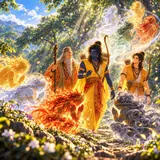
Scene 14 of 16 · Rama returns in the Pushpaka chariot and is crowned in Ayodhya.
देवताभ्यो वरं प्राप्य समुत्थाप्य च वानरान् । अयोध्यां प्रस्थितो रामः पुष्पकेण सुहृद्वृतः ॥ ८६ ॥
“Receiving a boon from the gods, he raised the fallen vanaras back to life, and set out for Ayodhya in the Pushpaka chariot, surrounded by friends.
“देवताओं से वर पाकर उन्होंने मरे हुए वानरों को फिर जीवित किया, और मित्रों से घिरे हुए पुष्पक विमान से अयोध्या की ओर चले।
CommentaryNot scripture Rama’s boon from the gods is not for himself: he asks that the fallen vanaras rise again. The Pushpaka is Kubera’s flying chariot, which Ravana had taken. Rama returns home in his enemy’s own vehicle, with friends all around him. Even victory, for Rama, is shared.
Scene 14 of 16 · Rama returns in the Pushpaka chariot and is crowned in Ayodhya.
भरद्वाजाश्रमं गत्वा रामः सत्यपराक्रमः । भरतस्यान्तिके रामो हनूमन्तं व्यसर्जयत् ॥ ८७ ॥
“Reaching Bharadvaja’s hermitage, Rama, whose prowess is truth, sent Hanuman ahead to Bharata.
“भरद्वाज के आश्रम पहुँचकर सत्य-पराक्रमी राम ने हनुमान को भरत के पास आगे भेजा।
CommentaryNot scripture At Bharadvaja’s hermitage, the same place where his exile journey stopped, Rama sends Hanuman ahead to Bharata. Why? In the Yuddha Kanda he wants to see Bharata’s face when he hears the news: if Bharata now loves the throne, Rama will leave it to him. Bharata’s joy answers the question.
Scene 14 of 16 · Rama returns in the Pushpaka chariot and is crowned in Ayodhya.
पुनराख्यायिकां जल्पन् सुग्रीवसहितस्तदा । पुष्पकं तत् समारुह्य नन्दिग्रामं ययौ तदा ॥ ८८ ॥
“Then, talking again of all that had passed, with Sugriva beside him, he mounted the Pushpaka and went to Nandigrama.
“फिर बीती बातों की चर्चा करते हुए, सुग्रीव के साथ, वे पुष्पक पर चढ़कर नंदीग्राम गए।
CommentaryNot scripture Kathayan : as they fly, they talk of everything that happened. The return journey becomes a retelling. In the full story, Rama points out every place below to Sita: here I grieved, here we built the bridge. The Ramayana is a story that its own heroes love to tell.
Scene 14 of 16 · Rama returns in the Pushpaka chariot and is crowned in Ayodhya.
नन्दिग्रामे जटां हित्वा भ्रातृभिः सहितोऽनघः । रामः सीतामनुप्राप्य राज्यं पुनरवाप्तवान् ॥ ८९ ॥
“At Nandigrama the sinless Rama, with his brothers, put off his matted hair, and having won Sita back, regained the kingdom.
“नंदीग्राम में निष्पाप राम ने भाइयों के साथ जटाएँ उतारीं, और सीता को पाकर फिर से राज्य प्राप्त किया।
CommentaryNot scripture At Nandigrama, the village from which Bharata ruled, all the brothers put off their matted hair (jata ) together. Exile ends with a simple act of grooming, almost a homecoming bath. Then Rama, with Sita restored, “regained the kingdom”. Fourteen years close in one line.
Scene 14 of 16 · Rama returns in the Pushpaka chariot and is crowned in Ayodhya.
प्रहृष्टमुदितो लोकस्तुष्टः पुष्टः सुधार्मिकः । निरामयो ह्यरोगश्च दुर्भिक्षभयवर्जितः ॥ ९० ॥
“The world is glad and joyful, content and thriving, devoted to dharma, free of sickness and disease, and without fear of famine.
“संसार प्रसन्न और आनंदित है, संतुष्ट और समृद्ध है, धर्म में लगा है, रोग और व्याधि से मुक्त है, और अकाल के भय से रहित है।
CommentaryNot scripture Now Narada describes Rama’s reign, Rama-rajya, as if it is happening right now. That is the startling point: Narada and Valmiki live in Rama’s own time. The world is glad, healthy and devoted to dharma. The poem was first told about a living king.
Scene 15 of 16 · Rama’s reign: a world without fear, hunger or grief.
न पुत्रमरणं केचित् द्रक्ष्यन्ति पुरुषाः क्वचित् । नार्यश्चाविधवा नित्यं भविष्यन्ति पतिव्रताः ॥ ९१ ॥
“No man anywhere will see the death of a son; women will never be widowed and will always be faithful to their husbands.
“कहीं कोई पुरुष पुत्र की मृत्यु नहीं देखेगा; स्त्रियाँ कभी विधवा नहीं होंगी और सदा पतिव्रता रहेंगी।
CommentaryNot scripture Two promises that every family understands: no parent will bury a child, no woman will be widowed. Tradition counts these as the deepest griefs of life. Rama-rajya is not only order and wealth. It is a world where the most painful losses do not happen.
Scene 15 of 16 · Rama’s reign: a world without fear, hunger or grief.
न चाग्निजं भयं किञ्चिन्नाप्सु मज्जन्ति जन्तवः । न वातजं भयं किञ्चित् नापि ज्वरकृतं तथा ॥ ९२ ॥
“There is no fear of fire at all, no creature drowns in water; there is no fear from the wind, nor from fever.
“आग का कोई भय नहीं है, कोई प्राणी जल में नहीं डूबता; न हवा का भय है, न ज्वर का।
CommentaryNot scripture Fire, water, wind and fever: the ordinary dangers of ancient life. In Rama’s kingdom none of them strikes. The list sounds simple, yet for people who lived in thatch houses near rivers and through epidemics, it describes the safest world they could imagine.
Scene 15 of 16 · Rama’s reign: a world without fear, hunger or grief.
न चापि क्षुद्भयं तत्र न तस्करभयं तथा । नगराणि च राष्ट्राणि धनधान्ययुतानि च ॥ ९३ ॥
नित्यं प्रमुदिताः सर्वे यथा कृतयुगे तथा । अश्वमेधशतैरिष्ट्वा तथा बहुसुवर्णकैः ॥ ९४ ॥
“There is no fear of hunger there and no fear of thieves. Cities and countries are full of wealth and grain, and everyone is always happy, as in the age of truth. Having performed a hundred horse sacrifices and others with rich gifts of gold,
“वहाँ न भूख का भय है, न चोरों का। नगर और देश धन-धान्य से भरे हैं, और सब लोग सत्ययुग की तरह सदा सुखी हैं। सौ अश्वमेध और सोने की भरपूर दक्षिणा वाले दूसरे यज्ञ करके,
CommentaryNot scripture Freedom from hunger and from thieves, and a land full of grain: Rama-rajya is described in plain terms anyone can value. “As in the age of truth” (krita-yuga ) means the first and best of the four ages. Then comes the great horse sacrifice (ashvamedha ), the rite of a righteous emperor, performed a hundred times.
Scene 15 of 16 · Rama’s reign: a world without fear, hunger or grief.
गवां कोट्ययुतं दत्त्वा विद्वद्भ्यो विधिपूर्वकम् । असंख्येयं धनं दत्त्वा ब्राह्मणेभ्यो महायशाः ॥ ९५ ॥
राजवंशान् शतगुणान् स्थापयिष्यति राघवः । चातुर्वर्ण्यं च लोकेऽस्मिन् स्वे स्वे धर्मे नियोक्ष्यति ॥ ९६ ॥
“having given ten thousand crores of cows to the learned according to the rites, and countless wealth to brahmanas, the greatly renowned Raghava will establish royal lines a hundredfold, and will set the four orders of this world each in its own dharma.
“विधि से विद्वानों को अरबों गौएँ और ब्राह्मणों को अपार धन देकर, महायशस्वी राघव सौ गुना राजवंश स्थापित करेंगे, और इस लोक के चारों वर्णों को अपने-अपने धर्म में स्थापित करेंगे।
CommentaryNot scripture The numbers are enormous (ten thousand crores of cows) and meant to be: they describe generosity without limit. Rama “will establish royal lines a hundredfold”, restoring old dynasties. He sets each of the four orders in its own dharma, which in the poem’s view means a society where everyone knows their duty and is protected in it.
Scene 15 of 16 · Rama’s reign: a world without fear, hunger or grief.
दशवर्षसहस्राणि दशवर्षशतानि च । रामो राज्यमुपासित्वा ब्रह्मलोकं प्रयास्यति ॥ ९७ ॥
“Having ruled the kingdom for ten thousand years and ten hundred years more, Rama will go to the world of Brahma.
“दस हज़ार और दस सौ वर्ष राज्य करके राम ब्रह्मलोक को जाएँगे।
CommentaryNot scripture Eleven thousand years of rule. The epic years are not meant as ordinary calendar years. They speak of a reign so long and stable that it became the measure of every good kingdom after it. Then Rama will go to Brahma’s world. Narada sees past the present into the end.
Scene 15 of 16 · Rama’s reign: a world without fear, hunger or grief.
इदं पवित्रं पापघ्नं पुण्यं वेदैश्च सम्मितम् । यः पठेद् रामचरितं सर्वपापैः प्रमुच्यते ॥ ९८ ॥
“This story of Rama is holy, it destroys sin, it is meritorious and equal to the Vedas. Whoever reads it is freed from all sins.
“राम का यह चरित्र पवित्र है, पाप नाशक है, पुण्यदायी है और वेदों के समान है। जो इसे पढ़ता है, वह सब पापों से मुक्त हो जाता है।
CommentaryNot scripture Here the summary ends and the blessing (phala-shruti ) begins: what a reader gains by reading. The Ramayana is called veda-sammita , equal to the Vedas. That is a bold claim for a poem. Tradition calls it the adi-kavya , the first poem, and treats it as scripture in story form.
Scene 16 of 16 · The blessing for all who read this story.
एतदाख्यानमायुष्यं पठन् रामायणं नरः । सपुत्रपौत्रः सगणः प्रेत्य स्वर्गे महीयते ॥ ९९ ॥
“A man who reads this tale, the Ramayana, which gives long life, will be honoured in heaven after death, with his sons, grandsons and companions.
“आयु बढ़ाने वाली इस रामायण कथा को पढ़ने वाला मनुष्य मृत्यु के बाद अपने पुत्रों, पौत्रों और साथियों सहित स्वर्ग में सम्मान पाता है।
CommentaryNot scripture Ayushya , “giving long life”: reading the Ramayana is said to bless the reader with years, family and honour after death. Notice that the blessing includes “sons, grandsons and companions”. The reading is never only for oneself; its merit spreads to the people one loves.
Scene 16 of 16 · The blessing for all who read this story.
पठन् द्विजो वागृषभत्वमीयात् । स्यात् क्षत्रियो भूमिपतित्वमीयात् ॥ वणिक् जनः पण्यफलत्वमीयात् । जनश्च शूद्रोऽपि महत्त्वमीयात् ॥ १०० ॥
“A brahmana who reads it attains mastery of speech; a kshatriya attains lordship of the earth; a merchant gains the fruit of his trade; and even a shudra attains greatness.”
“इसे पढ़ने वाला ब्राह्मण वाणी में निपुणता पाता है, क्षत्रिय पृथ्वी का स्वामित्व पाता है, वैश्य व्यापार का फल पाता है, और शूद्र भी महानता पाता है।”
CommentaryNot scripture The final verse offers a blessing to every class of society, each in its own terms: speech for the scholar, rule for the warrior, profit for the merchant, greatness for the worker. No one is left out. Narada’s tale is closed, and in the next sarga Valmiki, holding this story in his heart, walks to the river.
Scene 16 of 16 · The blessing for all who read this story.